Defining Dialect in Hibernate

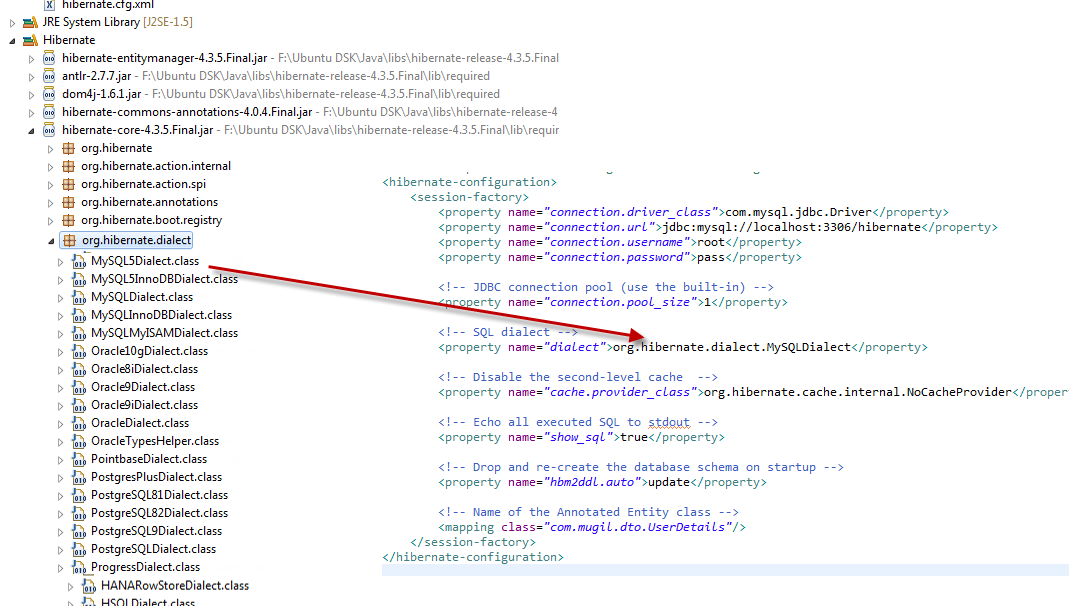
MySQL Dialect
MySQL Dialect

<!DOCTYPE hibernate-configuration PUBLIC
        "-//Hibernate/Hibernate Configuration DTD 3.0//EN"
        "http://www.hibernate.org/dtd/hibernate-configuration-3.0.dtd">
<hibernate-configuration>  
    <session-factory>
        <property name="connection.driver_class">com.mysql.jdbc.Driver</property>
        <property name="connection.url">jdbc:mysql://localhost:3306/hibernate</property>
        <property name="connection.username">root</property>
        <property name="connection.password">pass</property>
        
        <!-- JDBC connection pool (use the built-in) -->
        <property name="connection.pool_size">1</property>

        <!-- SQL dialect -->
        <property name="dialect">org.hibernate.dialect.MySQLDialect</property>

        <!-- Disable the second-level cache  -->
        <property name="cache.provider_class">org.hibernate.cache.internal.NoCacheProvider</property>

        <!-- Echo all executed SQL to stdout -->
        <property name="show_sql">true</property>

        <!-- Drop and re-create the database schema on startup -->
        <property name="hbm2ddl.auto">update</property>
        
        <!-- Name of the Annotated Entity class -->
        <mapping class="com.mugil.dto.UserDetails"/>
    </session-factory>
</hibernate-configuration>

If hbm2ddl.auto is set to create the table will be created every time when java class is Run.The old records will be deleted.

<property name="hbm2ddl.auto">create</property>

When set to update the records will be added without new table creation

<property name="hbm2ddl.auto">update</property>

More Annotations

3

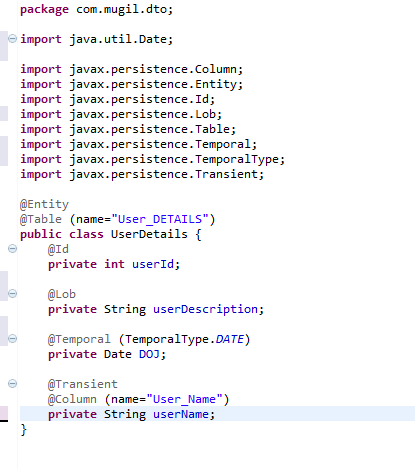
@Transient tells not to create Column
@Column tells the Hibernate the Name under which column need to be
created in Db table.

@Transient 
@Column (name="User_Name") 
private String userName; 

@Temporal tells the option of selective addition.Below I am adding Date rather than
Date & time as Timestamp

 @Temporal (TemporalType.DATE) 
 private Date DOJ;

@Lob – Large Object, Telling Hibernate to create Large Object Datatype fro Column
@Lob over String creates CLOB
@Lob over Byte creates BLOB

 @Lob
 private String userDescription;

Simple Hibernate Table Creation from Scratch

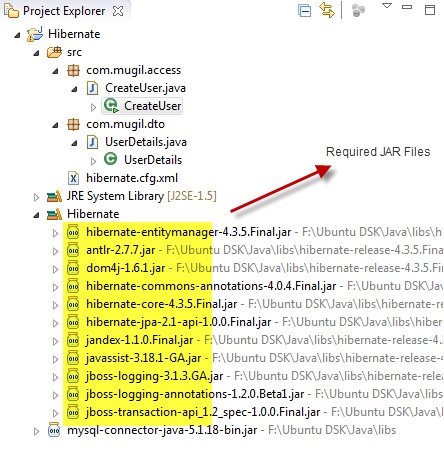
Hibernate Required Jar Files List

Step1: Create a Bean for which Table should be created in Database
Step2: Create a Class which uses the bean.

Step 1

package com.mugil.dto;

import javax.persistence.Entity;
import javax.persistence.Id;

@Entity 
public class UserDetails {
	@Id	
	private int userId;
	private String userName;
	
	public int getUserId() {
		return userId;
	}
	
	public void setUserId(int userId) {
		this.userId = userId;
	}
	
	public String getUserName() {
		return userName;
	}
	
	public void setUserName(String userName) {
		this.userName = userName;
	}
}

Step 2

package com.mugil.access;

import org.hibernate.Session;
import org.hibernate.SessionFactory;
import org.hibernate.boot.registry.StandardServiceRegistryBuilder;
import org.hibernate.cfg.Configuration;
import org.hibernate.service.ServiceRegistry;

import com.mugil.dto.UserDetails;

public class CreateUser {
	private static ServiceRegistry serviceRegistry;
	private static SessionFactory sessionFactory;
	
	public static void main(String[] args) {
		UserDetails objUserDetail =  new UserDetails();
		objUserDetail.setUserId(101);
		objUserDetail.setUserName("Mugil");
		
		SessionFactory sessionFact = createSessionFactory();
		Session session = sessionFact.openSession();
		session.beginTransaction();
		session.save(objUserDetail);
		session.getTransaction().commit();	
	}
	
	
	public static SessionFactory createSessionFactory() {
	    Configuration configuration = new Configuration();
	    configuration.configure();
	    serviceRegistry = new StandardServiceRegistryBuilder().applySettings(
	            configuration.getProperties()).build();
	    sessionFactory = configuration.buildSessionFactory(serviceRegistry);
	    return sessionFactory;
	}
}

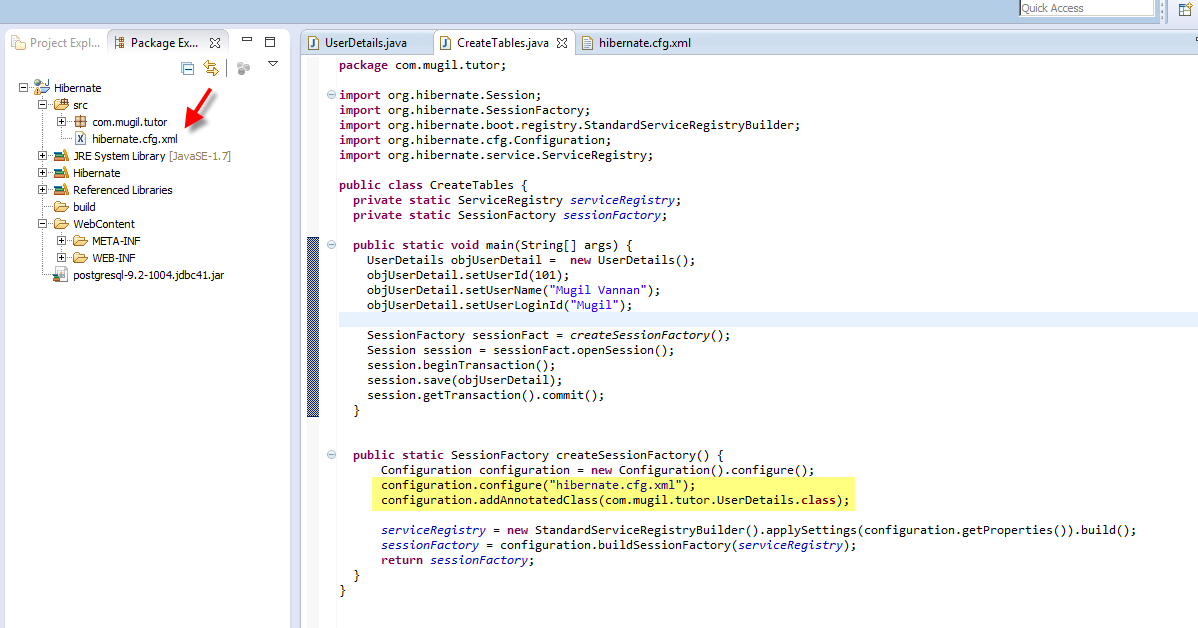
In Some cases the hibernate.cfg.xml might become unrecognized.In such case the code should be changed to force the config to be picked from the file location.

public static SessionFactory createSessionFactory() 
{
  Configuration configuration = new Configuration().configure();	  
  configuration.configure("hibernate.cfg.xml");	  
  configuration.addAnnotatedClass(com.mugil.tutor.UserDetails.class);
	  
  serviceRegistry = new   StandardServiceRegistryBuilder().applySettings(configuration.getProperties()).build();
  sessionFactory = configuration.buildSessionFactory(serviceRegistry);
  return sessionFactory;
}

Hibernate uses SessionFactory pattern internally as below

SessionFactory sessionFact = createSessionFactory();
Session session = sessionFact.openSession();
session.beginTransaction();
session.save(objUserDetail);
session.getTransaction().commit();	

1.Create Object for SessionFactory
2.Open Session to begin Transaction
3.Begin Transaction using beginTransaction() Method
4.Save the Object by Passing Object of the bean
5.Complete the Transaction using commit

Annotations
@Entity – Means entity as a whole>table would be created by the Name of the Entity
@Id – Tells the Primary Key

Having a Different table name from Class Name
Annotations

@Entity(name="User_Details")
public class Users 
{
 .
 .
}

Table with User_Details would be created instead of Users

Having a Different Column name from Object Name
Annotations

@Entity(name="User_Details")
public class Users 
{
 @Id
 @Column(name="USER_ID")
 private String UserId;
 .
 .
}

Columns with User_Id would be created instead of UserId

Appending String to Getters

public void setName(String name) 
{
  Name = name + " Append Test ";
}

Appending String to Getters

@Entity
@Table (name="User_Details")
public class Users 
{

}

The Entity Name Still remains the same but the table Name is different.

@Basic Annotation – Tells Hibernate to persist which it does by default

public class Users 
{
 @Basic
 private String UserName;
 . 
 .
}

@Basic has 2 Parameters – Fetch, optional. The only time you use @Basic is while applying the above options.

@Transient Annotation – Tells Hibernate to not store data in database

public class Users 
{
 @Transient
 private String UserName;
 . 
 .
}

@Temporal Annotation – Tells Hibernate to specify Date or Time

public class Users 
{
 @Temporal (TemporalType.Date)
 private String joinedDate;
 . 
 .
}

Without @Temporal the joinedDate is store along with TimeStamp in DB. Now using TemporalType(which is ENUM) you can select the type of data which can be stored in Database.

@Lob – Tells Hibernate to specify Date or Time

public class Users 
{
 @Lob
 private String Address;
 . 
 .
}

Tells the database field should be created as CLOB instead of VARCHAR(255).