Factory allows the consumer to create new objects without having to know the details of how they’re created, or what their dependencies are – they only have to give the information they actually want.
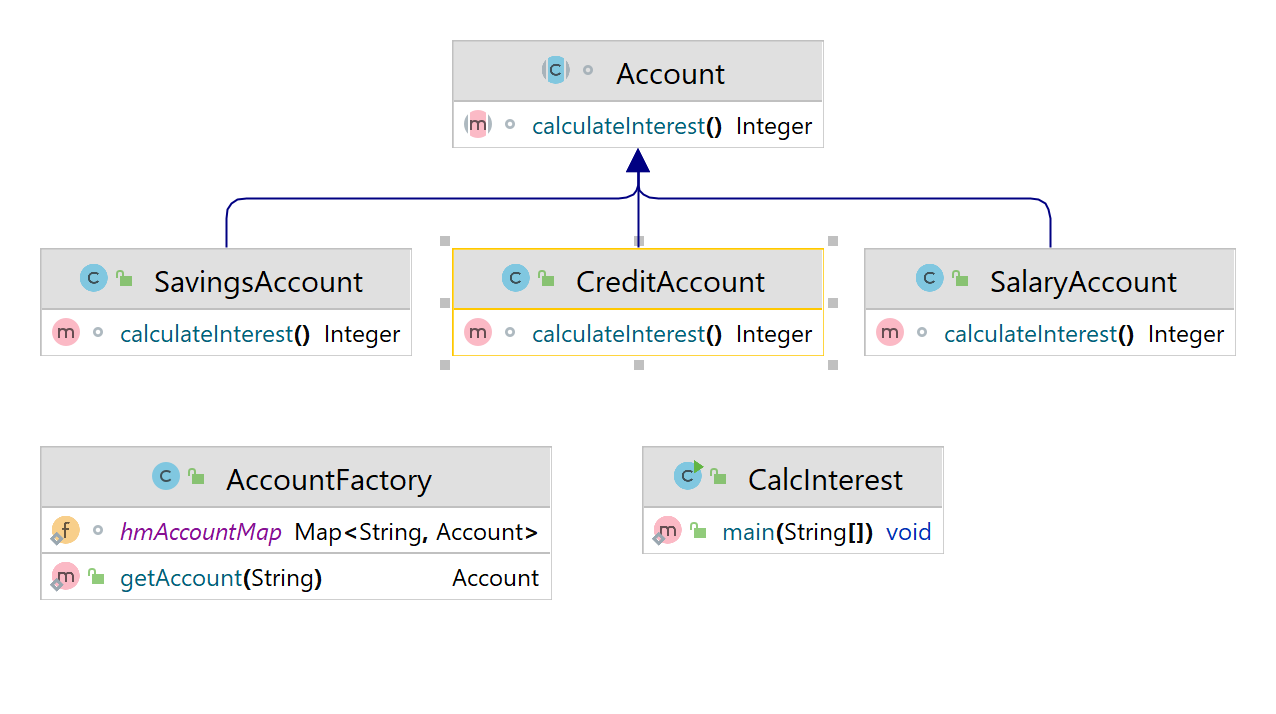
Account.java
abstract class Account {
   abstract Integer calculateInterest();
}
CreditAccount.java
public class CreditAccount extends Account{
    @Override
    Integer calculateInterest() {
        return 11;
    }
}
SalaryAccount.java
public class SalaryAccount extends Account{
    @Override
    Integer calculateInterest() {
        return 5;
    }
}
SavingsAccount.java
public class SavingsAccount extends Account{
   @Override
    Integer calculateInterest() {
        return 7;
    }
}
AccountFactory.java
public class AccountFactory {
    static Map<String, Account>  hmAccountMap =  new HashMap<>();

    static {
        hmAccountMap.put("SavingsAcc", new SavingsAccount());
        hmAccountMap.put("CreditAcc", new CreditAccount());
        hmAccountMap.put("SalaryAcc", new SalaryAccount());
    }

    public static Account getAccount(String accountType){
        return hmAccountMap.get(accountType);
    }
}
CalcInterest.java
public class CalcInterest{
    public static void main(String[] args) {
        Account objAccountFactory = AccountFactory.getAccount("SavingsAcc");
        System.out.println("Interest rate is - " + Optional.of(objAccountFactory.calculateInterest()));
    }
}
Using Streams for AccountFactory Class
AccountFactory.java
public static Optional<Account> getAccount(String accountType) {
        return hmAccountMap.entrySet().stream()
                                      .filter(accParam -> accParam.getKey().equals(accountType))
                                      .findFirst()
                                      .map(Map.Entry::getValue);
}
CalcInterest.java
public class CalcInterest{
    public static void main(String[] args) {
        Account objAccountFactory = AccountFactory.getAccount("SavingsAcc");
        System.out.println("Interest rate is - " + Optional.of(objAccountFactory.calculateInterest()));
    }
}
Output
Interest rate is - 7